
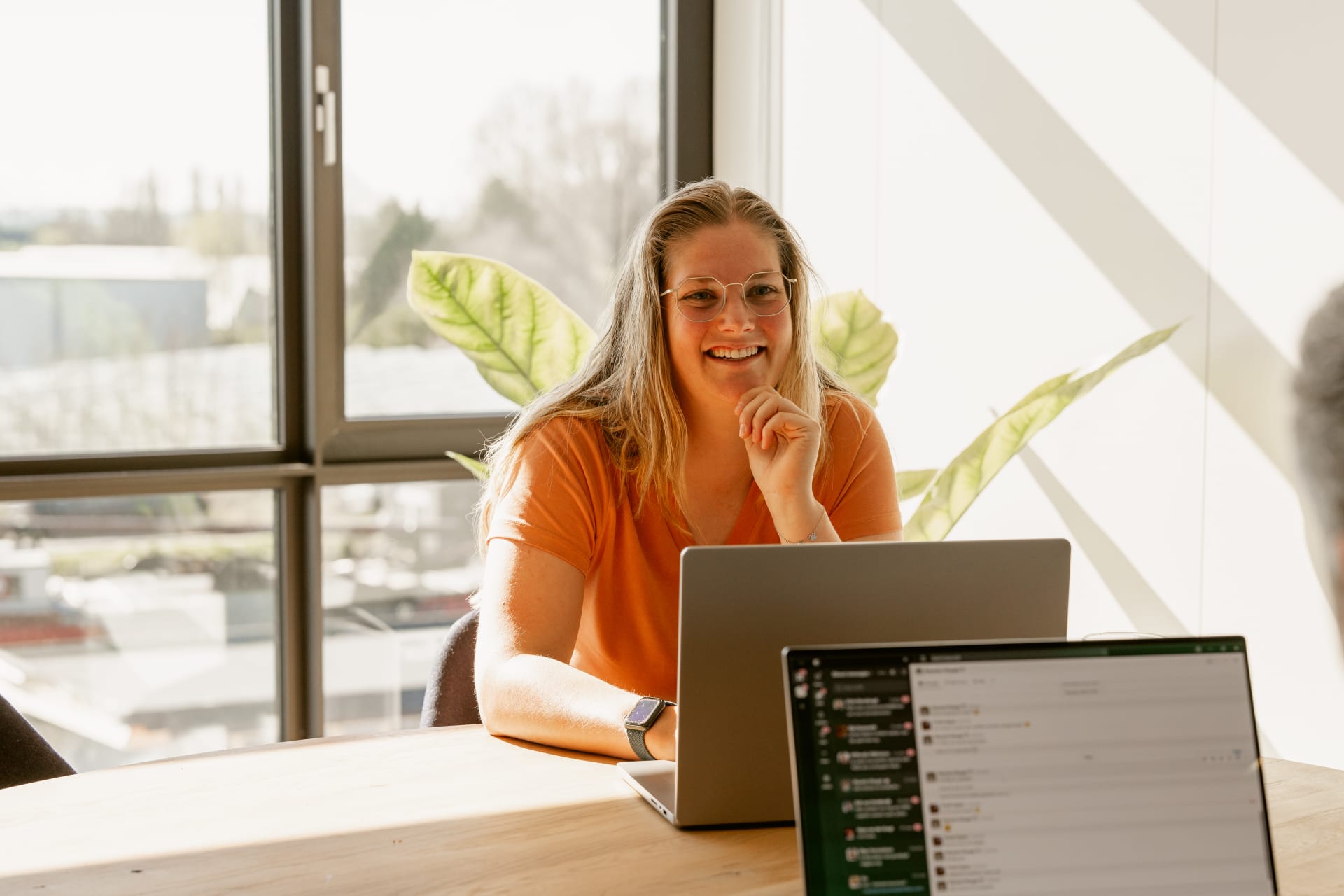
At Hypersolid, we believe great digital products are created by people who care. Our colleagues are the driving force behind everything we build. That is why we regularly spotlight one of them, sharing their story and what it is like to be part of our culture.
Tech Lead Shyanta Vleugel started as a graduation intern and, over the course of eight years, grew into a key role within our media team. What stands out in her story is not a tightly mapped-out career path, but a natural progression driven by curiosity, freedom, and the willingness to take on new challenges.
Q: How did you start at Hypersolid, and how has your role evolved?
In 2018, I did my internship at Beast, a small digital agency that was already working with Hypersolid. For my graduation project, someone suggested I apply here, which is how I first got in touch with Hypersolid.
I started as a graduation intern from Communication & Multimedia Design at the Amsterdam University of Applied Sciences. My research focused on progressive web apps for Max Verstappen. These are essentially websites you can install on your phone and open separately, almost like a native app. Interestingly, that research also led us to build our internal company app as a progressive web app at the time.
After that, I was offered a position as a junior web developer. In the beginning, I mainly worked on smaller projects, mostly for Talpa. It was a period focused on building and gaining experience. That’s where I really built a solid foundation.
After a while, I joined the NLZIET team because there was a need for a developer. There, I rebuilt the website. First from Angular to React, and then into a completely new design. Fairly quickly, I took the lead on web development for that project. It happened quite naturally. There was a lot of work, and someone had to take ownership, so I stepped in.
From that point on, I moved more toward media and video, including Chromecast and smart TV development. That was partly driven by the work, but also by personal interest. Media has always been something I’m drawn to. At home, the TV is almost always on, and I use pretty much every streaming service. From Netflix to podcasts and music, there’s always something playing.
That makes it even more fun to work on these kinds of projects. You’re building something you actually use yourself.
My mentor at the time played a big role in my development. Without him, I wouldn’t be where I am today. He didn’t just share knowledge, but more importantly gave me the confidence to take the next steps.
Q: When did you notice your work changing, and what do you enjoy most now?
That shift happened quite gradually. I started building fewer features and became more involved in complex bugs and troubleshooting. My weeks also became less predictable. At the start of the week, I often didn’t know what I’d be working on, but something challenging would always come up that I could dive into.
At the same time, I became more involved in the bigger picture: planning, tickets, design, and how everything comes together. I also started aligning more with the Tech Lead at the time and noticed that the role increasingly appealed to me.
The turning point came when I was given the opportunity to design a complete video player from start to finish. That had been a long-term goal of mine. But once the plan was in place, I realized that I didn’t actually enjoy the building part anymore.
What gives me energy is structuring solutions, creating plans, and defining architecture. But also guiding people.
That’s still what I enjoy most. I get energy from both designing solutions and seeing others grow. I’ve always mentored interns and also teach at the university. The moment when something clicks for someone never gets old.
Q: Which project has stayed with you the most, and what are you most proud of?
NLZIET is really the common thread throughout my time here. It’s the project I’ve worked on the most and definitely learned the most from.
My first project, Veronica Inside, also really stuck with me. It was intense right away. Tight deadline, a lot of pressure, and still having to learn everything. But we delivered and went live. It immediately showed how we work here: everyone pulls together and helps each other where needed.
If I look at what I’m most proud of, it’s the Smart TV trajectory for NLZIET. We spent about nine months refactoring and improving the entire app. Since then, it has become the leading platform. That was a major shift and something I’m still proud of.
Q: How has Hypersolid supported your growth, and how do you view personal development?
For me, it comes down to the freedom you get here. When development started to interest me less and I began exploring other areas, I was given the space to do so. At one point, I even asked my manager if that was okay. The answer was simple: “I haven’t held you back, have I?”
That says everything.
You’re not locked into one role here. If you want to try something else, you can. That freedom, combined with guidance in small steps, has really helped me grow.
Personal development is very important to me. I need to stay challenged, otherwise I become stagnant. I always say I’m still a student who performs best under pressure.
So I actively look for things I don’t know yet. New technologies, new domains, courses. I make sure I keep moving.
The development reviews and coaching have also helped. It’s valuable to get feedback, especially on what can be improved. It’s nice to hear what’s going well, but that’s where I can really make progress.
Q: You also teach at the university. How did that come about, and what do you get out of it?
I was approached by a former teacher who asked if I wanted to help teach. At the same time, I felt that Hypersolid wasn’t very well known within that program, even though it’s actually a great match.
I decided to just give it a try, and it turned out to be a good fit. Every year, several interns come from there, and a large part of our teams has that background.
But I mainly do it because I enjoy it.
I’ve been in that position myself and know how difficult some things can be. I teach a subject that I once found very challenging. And at some point, I realized I fully understood it and could explain it clearly. That moment when it clicks for someone is still the most rewarding.
Q: How would you describe your style as a Tech Lead?
I try to stay close to people and be present on the floor as much as possible. That way, you get a better sense of how things are going and can easily check in.
I have a lot of small conversations. Sometimes during stand-ups, sometimes one-on-one. I approach it with empathy: how is someone doing, and where can I help?
I don’t have all the answers, and that’s okay. Sometimes I help by thinking things through together. Other times by pointing someone in the right direction.
And I think it’s important that people keep discovering things themselves. That’s ultimately how you learn the most.
Q: If we talk again in three to five years, what will you be doing?
I feel like I’m still at the beginning of being a Tech Lead. I have a strong frontend foundation, but a Tech Lead looks at the entire product.
So over the next few years, I want to broaden my scope. Learn more about backend, infrastructure, hosting, and everything around it. I know a bit, but not enough yet.
I also think it would be good to look beyond media. Media is a niche where I have a lot of experience, but it also means you start seeing the same patterns.
If you step into a completely different domain, you have to learn everything again. And that’s where real growth happens.
In three to five years, I’ll most likely still be working as a Tech Lead, but with a much broader knowledge base.
And I’ll probably still be challenging processes that don’t work, to see if I can improve them and leave things better than I found them.
People & Stories
Get in touch
Solid change starts here
Alon Basoglu
Head of Talent Acquisition
