
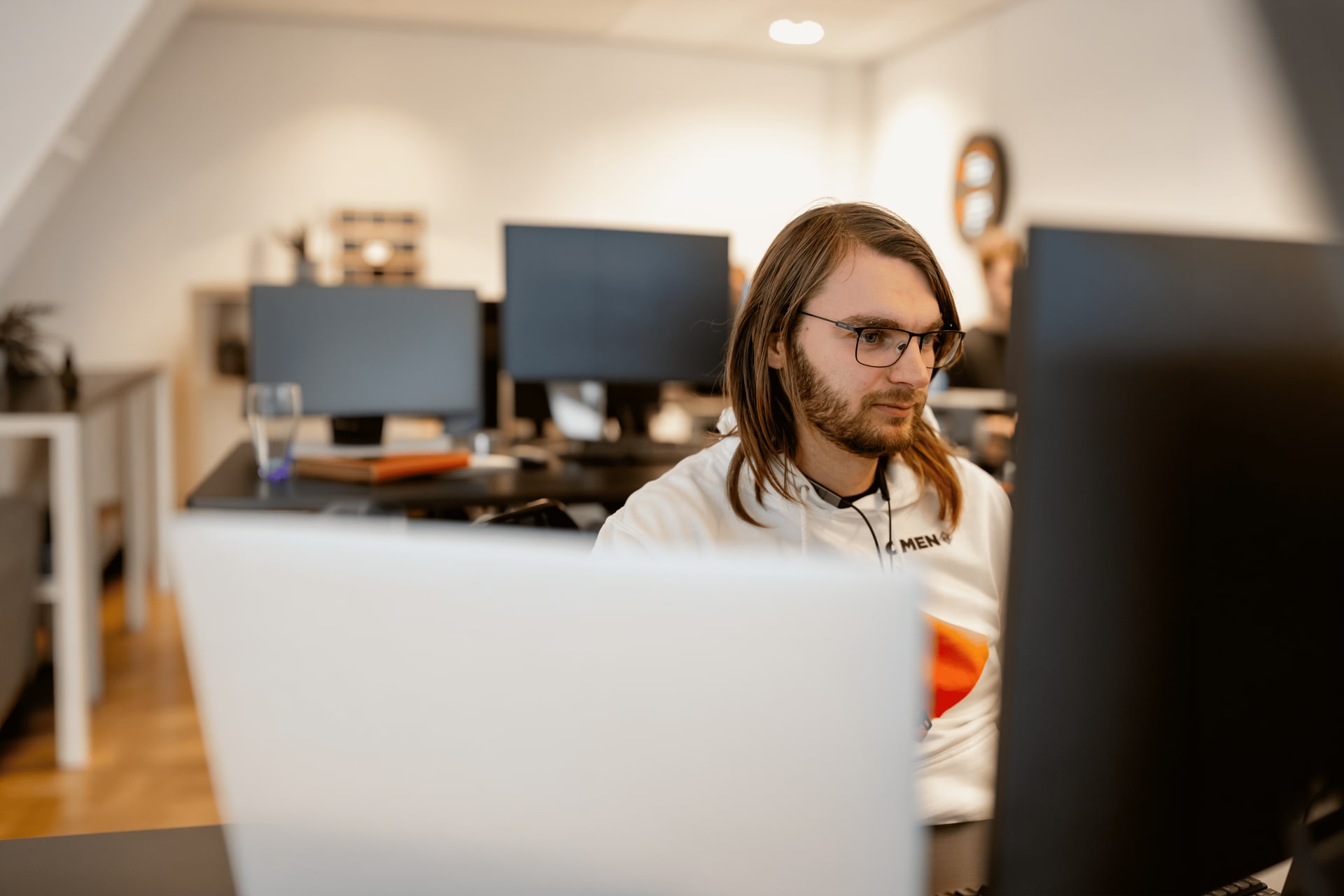
At Hypersolid, we believe great digital products are created by people who care. Our colleagues are the driving force behind everything we build. That is why we regularly spotlight one of them, sharing their story and what it is like to be part of our culture.
Developer Raav Schravesande has spent years working at the intersection of backend and AI. Where he once focused on building his own machine learning models, his work looks completely different today. Not because his role has disappeared, but because the field itself has changed at high speed.
Q: What does your dual role at Hypersolid look like, and how has it evolved?
From the start, more than seven years ago now, I’ve been part of our Backend (.NET) team. Within that team, I’ve also had the opportunity to contribute to AI projects as an AI developer. That kind of dual role is something you see more often here among colleagues.
I try to keep the balance between backend and AI work roughly fifty-fifty, although what that looks like has changed over time. It used to be quite structured: half my week on AI, the other half on backend. Nowadays, it’s much more intertwined and shifts back and forth more frequently.
In my day-to-day work, I’m involved in projects driven by the data and AI team on one hand, and .NET backend projects on the other. At the same time, you notice that even within backend work, AI tools are used more and more, which makes that separation less clear in practice.
I’ve also grown in my role. I take on more coordination, distribute work across colleagues, and contribute more actively to technical direction.
Q: How has the AI work itself changed?
What we consider AI work has really evolved over time. When I started, we were mainly building our own machine learning models. Think of classic classification and regression models, often tailored to a specific client or problem.
That has largely shifted toward using existing APIs and language models. Many of the solutions we used to build ourselves can now be implemented relatively easily with existing tools.
We’ve always focused on what’s new in the market and where the state of the art is. The difference now is that these models have become so large and powerful that you no longer run them yourself. In practice, you’ve become dependent on external providers.
There are two sides to that. On one hand, it’s a bit of a shame because you’re less involved in building those models yourself. On the other hand, it makes the work much faster and more accessible.
Q: Do you see AI becoming part of every developer role?
In a way, yes. AI tools have become a standard part of how we work. Whether you’re a backend or frontend developer, you use them to build faster and more efficiently.
That doesn’t mean the role of the developer is disappearing. You still need people who understand what’s happening and can steer quality.
What does change is how you work. More and more tasks are shifting to tooling. Things you used to do manually can now be delegated. That moves your role more toward reviewing, guiding, and understanding what’s happening under the hood.
Q: What gives you the most energy in your work right now?
For me, it’s mainly about solving problems. The start of a project, where you try to understand what the problem really is and how best to approach it, is the most enjoyable part.
I tend to move quickly toward the practical side. Instead of fully mapping everything out first, I prefer to start building to see what works.
With larger projects, you obviously need to go through those formal steps properly. But in smaller projects, it can be more efficient to put something together right away and build from there.
That balance is always a trade-off. Sometimes a project turns out to be more complex than expected, and that’s when you realize how important it is to have a solid foundation.
Q: You work a lot with clients. What misconceptions do you often see around AI?
The biggest misconception is that AI will solve the problem on its own.
Many companies come to us saying, “We want to do something with AI,” often based on what they’ve seen in tools like ChatGPT or other recent developments.
In practice, that question is often less about AI and more about automation. Sometimes AI is the right solution, but not always.
There’s also the idea that a single prompt can automate everything. In reality, a solution needs to be reliable and consistent. That still requires a strong technical foundation and clear decisions.
A large part of our work is therefore about sharpening the question. What problem are you trying to solve, and which technology fits best?
Q: You’re part of the AI Guild. What role does it play within Hypersolid?
The AI Guild is a group of colleagues actively working on AI and new developments in that space. What you see is that AI is becoming more accessible. You don’t necessarily need a deep background in machine learning to work with it, which means more people are experimenting with it.
Within the guild, we share knowledge, test new tools, and assess what’s relevant for the organization. We also have the space to try out tooling, which is important because many of these solutions come with costs and have implications for privacy and security.
In that sense, the AI Guild also acts as a first filter. We evaluate which tools are interesting and how we can use them responsibly within the company.
What stands out is that Hypersolid is quite advanced in an AI-first way of working. At many companies, AI tools are available, but usage tends to be more individual. Here, it’s actively encouraged to use them and explore how they fit into your daily work. That makes AI a more natural part of development, rather than something you occasionally add on.
Q: You also give workshops and guest lectures. How does that fit into your work?
I studied Computer Science at InHolland Haarlem and, at the time, attended guest lectures on Azure DevOps given by someone who worked at Hypersolid then and still does now. Interestingly, I’ve partly taken over that role in recent years.
I now give workshops and guest lectures on Azure, Azure DevOps, and Natural Language Processing. That last topic aligns closely with my daily work.
I developed and introduced those NLP workshops at InHolland myself. It took more time than I initially expected, but fortunately I get the space from Hypersolid to do it. I can prepare and teach during working hours.
Q: How do you personally stay up to date in such a fast-changing field?
I usually start with tutorials and rebuilding basic concepts. After that, I quickly move on to building things myself.
I work with Python and C# .NET, and since those languages are fairly similar, it’s easier to pick up new things.
I also try to attend meetups. Especially early in your career, they’re great for networking, but they remain valuable afterward as well.
You see how other organizations approach things, what choices they make, and why. I get a lot of inspiration from that, including for my own side projects.
Q: Looking ahead, how do you see your role evolving further?
I expect that combination of backend and AI to remain, but the content will continue to change.
We’re moving more toward using tooling and automation. Less building everything yourself, more steering how those tools are used and controlled. At the same time, the core remains the same: helping clients solve problems.
Only the way you do that changes. And as a developer, you evolve along with it.
People & Stories
Get in touch
Solid change starts here
Alon Basoglu
Head of Talent Acquisition
