
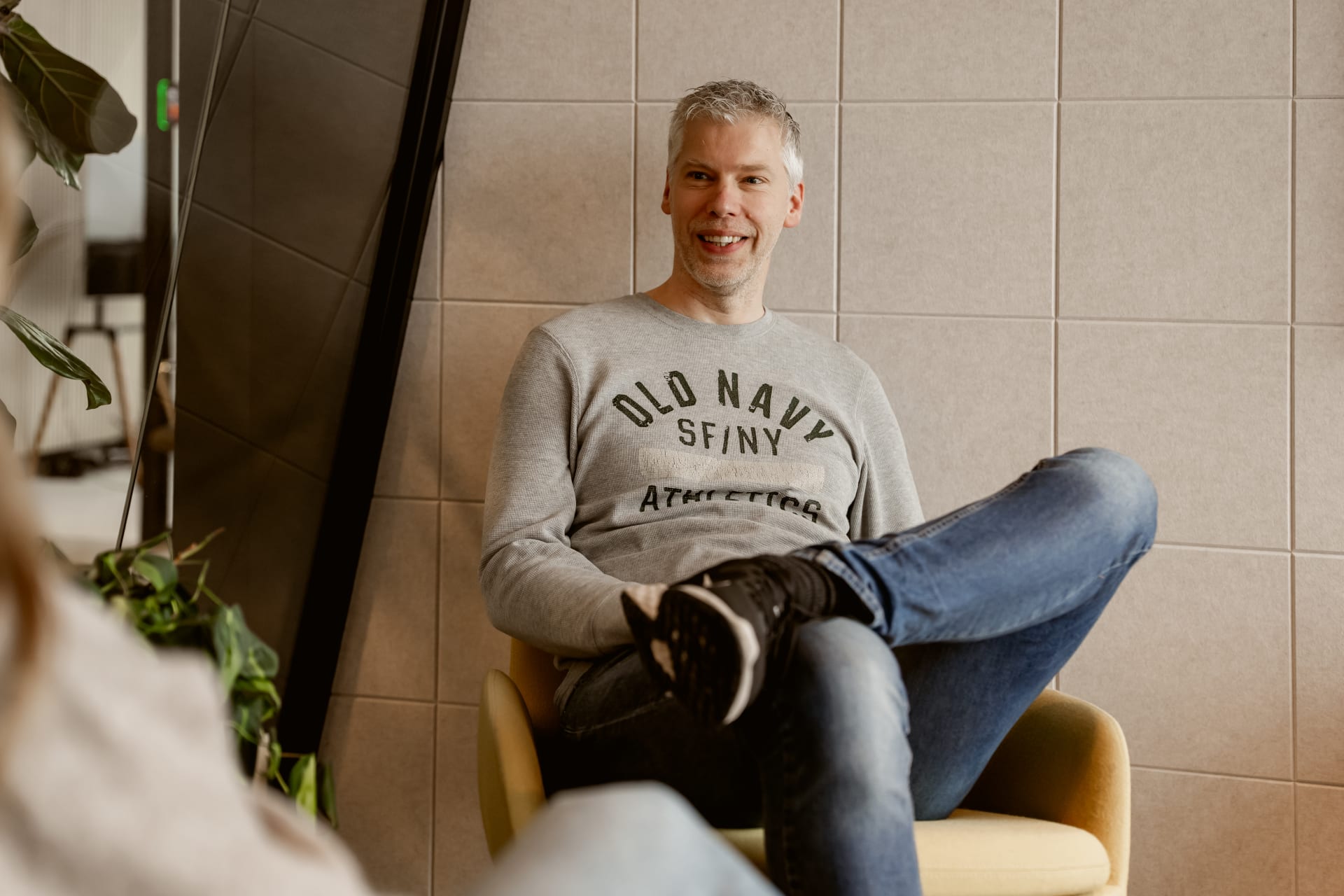
At Hypersolid, we believe great digital products are created by people who care. Our colleagues are the driving force behind everything we build. That is why we regularly spotlight one of them, sharing their story and what it is like to be part of our culture.
Pieter Dubelaar has been with Hypersolid for over ten years. In that time, he has become one of the most recognizable faces for clients, colleagues, and community members alike. Not as a traditional architect focused purely on technology, but as a connector who moves effortlessly between client and team, idea and execution, complexity and simplicity. A role that fits him naturally.
Q: How did you end up at Hypersolid?
It’s always a great story to look back on. Before this, I worked at a small web agency in Amsterdam, where I did a bit of everything: technical pre-sales, managing developers, troubleshooting firewalls. I enjoyed it, but at some point I started missing people to spar with. Especially when Agile and Scrum were just starting to emerge. I was kind of stuck in a single bubble.
So I decided to organize it myself. I started a LinkedIn group for tech leads in North Holland to connect with like-minded people. Through that group, I got in touch with Reinier Maarschalk. We met up to exchange ideas. It was supposed to be a one-hour conversation, but it turned into three. That alone showed there was a real need for it.
Through him, I was also introduced to Hypersolid. I already knew the company a bit from earlier. I had once helped out on a Talpa project and occasionally visited the office, so it wasn’t unfamiliar.
At some point, I reached out to Gijs Zonneveld, one of the early Hypersolid team members, just to exchange experiences. But that conversation took a different turn than expected. We started by getting to know each other, but quickly it felt more like a job interview. It all felt very natural.
During that same conversation, I was offered a position. There wasn’t a formal role yet, but they were willing to create one for me. I decided to go for it.
Q: How has your role evolved here?
I started as something like the right hand to Roy Meister on the Heineken account. I mainly brought web expertise, since Hypersolid was still heavily focused on mobile development at the time. There was a need to expand web capabilities. In the first few months, I still did some programming myself on a web project. After that, not anymore.
One thing I remember well is the first proposal I wrote. I priced it way too low for what the project was actually worth—still stuck in a bit of a penny-pinching mindset. Roy looked at it and said, let’s just do it and see what happens. And surprisingly, it worked out. But it wasn’t a blueprint for success. If anything, it just shows where I started.
From there, my role shifted pretty quickly toward pre-sales and guiding teams. At some point, I also started leading the .NET team. That was supposed to be temporary, but it ended up lasting seven years. So not that temporary after all.
Over time, I became more involved in sales processes as well. Together with Lennart van Wijk, I worked on many trajectories, first within Heineken and later beyond. That’s how my role gradually evolved into what we now call a Solution Architect.
Q: What does your role as a Solution Architect involve?
For us, that role is mainly focused on technical pre-sales. In a typical trajectory, you work closely with someone from the commercial side. My role is to represent the technical perspective. It always starts with listening carefully. Asking the right questions. Understanding what someone really means, even if it’s not fully clear yet.
Then comes translation. On one side, translating to the client in clear, understandable language. On the other, translating to our teams who will actually build the solution. You’re constantly moving between those two worlds. That also includes structure, like drafting a statement of work, defining assumptions, and helping estimate the work.
What works well for me is to make an initial estimate myself. Not just asking, “how long will this take?”, but saying, “I think four days, what do you think?” That tends to get people to respond more quickly and helps you arrive at something realistic together.
What stands out is how much freedom there is in this role. We don’t have a strictly defined process for pre-sales. That sometimes makes it less efficient, but more effective. Everyone has their own way of working.
At the same time, we are working on standardizing certain parts, especially the less interesting ones. AI helps with that. But a large part of the work remains custom, because every client and context is different. For example, I recently worked with a PIM system that was completely new to me. That’s just part of the job. You have to be able to switch quickly and pick things up fast.
Q: How technically involved are you still in solutions?
Mostly at a high level. I help shape the direction and the solution, but I consciously leave the details to the teams. They are closer to the technology and have the most up-to-date knowledge.
That said, it varies per project. Sometimes I stay involved longer and remain engaged during the build phase, more as a technical lead. But in general, my strength is not in the depth, but in maintaining overview and translating.
I’m also quite pragmatic. Not every project needs to be a Ferrari. Sometimes a Fiat is perfectly fine. If something can be simple, it should be simple.
Of course, if there are real technical requirements that demand complexity, you go there. But my starting point is always: keep it simple. Clear, understandable solutions often win over technically perfect but overly complex ones.
Q: Which projects have stayed with you the most?
One project I always remember is Star of the Match for Heineken. An international campaign, lots of pressure, short deadlines. A lot of last-minute work, sometimes solving things in the evening or at night. Not necessarily healthy, but the kind of project you look back on with energy. Especially because you do it together and everything eventually falls into place.
I also won’t forget my very first assignment here. It was a landing page for a game with Messi. Pretty straightforward, until we realized he would promote it to his millions of followers. So there I was, just a month in, working on something that could suddenly be used by massive numbers of people at the same time. Those moments stick with you.
But in the end, the energy for me doesn’t come from the project or the technology itself. It comes from collaboration. With colleagues and with clients. When there’s a good connection, you want to build something great together, and the type of project matters less.
I can honestly say I’ve never felt like I didn’t want to come to the office. What does drain energy are situations where collaboration doesn’t go smoothly. Fortunately, those are exceptions.
Q: You’re heavily involved in the Hyperlab. What makes it so important?
The Hyperlab is one of our key differentiators. There are many digital agency-type companies out there, but the way we approach media and innovation, and how we showcase it, is quite unique. It’s really part of who we are.
It may not always generate direct revenue, but it keeps clients engaged. It sparks interest and brings them back.
Personally, I just enjoy being part of it. Talking to people, exploring ideas, and translating that into stories others can understand.
At the same time, it does require attention. People who are heavily involved in projects sometimes have less room for it. That’s always been the case. And there are more constraints now, like security and compliance.
But the space is still there. With initiatives like our POC factory and available budgets, you can really take things on. It often comes down to visibility and priority. When you activate that, ideas naturally start to flow again. I personally don’t mind explaining things or speaking in front of a group, so I’m happy to take on that role.
Q: What do you think makes people stay here for so long?
It’s a combination of things. We have a culture where people support each other. That sense of family we often talk about is real. There’s also a lot of attention for employees and room to experiment.
The innovation aspect plays a big role as well. It ultimately makes you proud of where you work. I always say: it’s a gift to be able to show someone around our office.
People & Stories
Get in touch
Solid change starts here
Alon Basoglu
Head of Talent Acquisition
